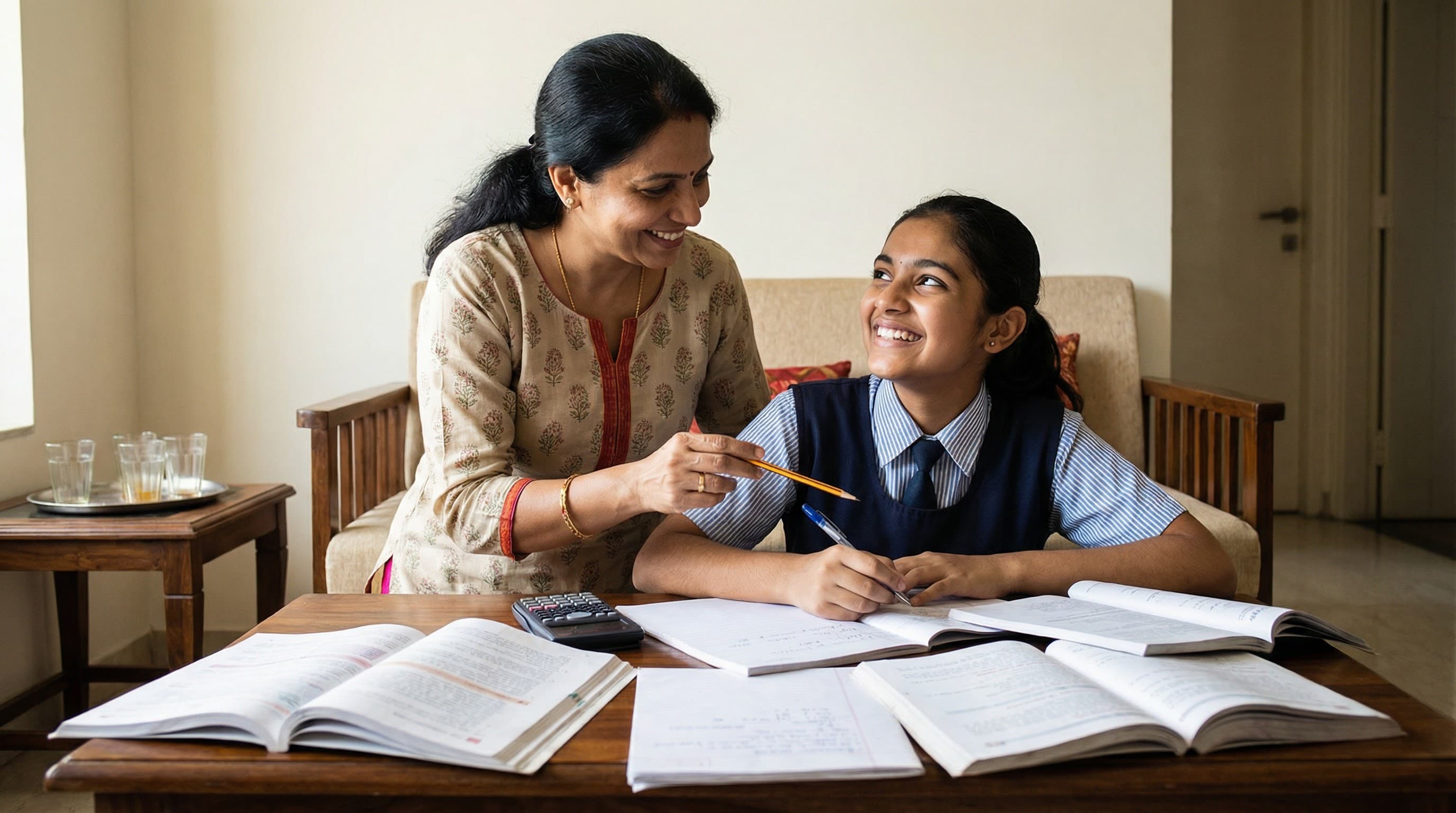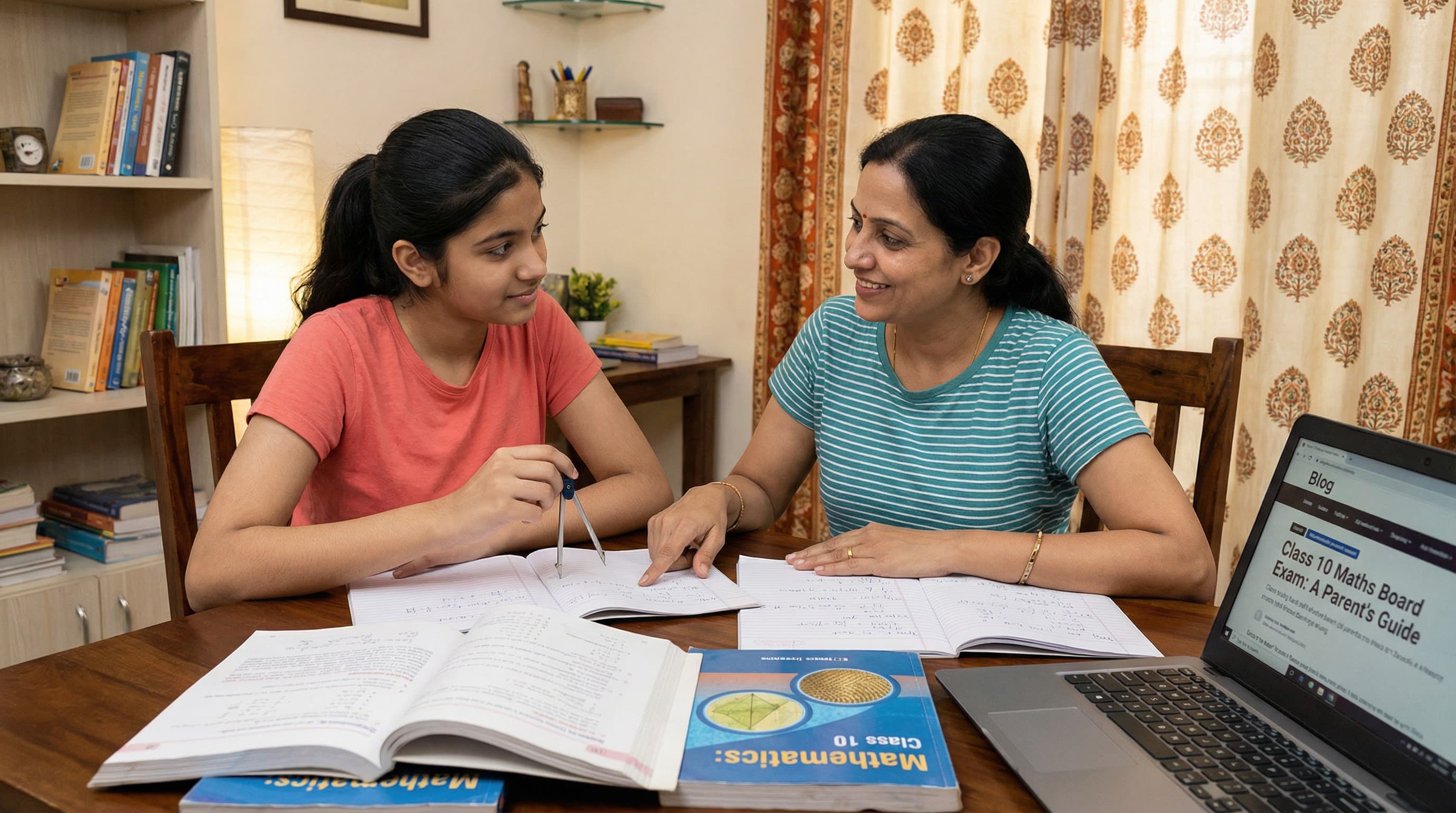
Class 10 Maths board exams (CBSE, ICSE, state boards) decide stream selection and future options. This guide helps Indian parents understand the syllabus, support preparation, and reduce exam stress for their 10th standard child.
Why Class 10 Maths Board Exam Matters for Indian Students
Class 10 board marks influence stream selection (Science, Commerce, Arts), college admissions, and scholarship eligibility. Maths is compulsory in most boards and often determines whether a child can pursue PCM (Physics, Chemistry, Maths) or PCB (Physics, Chemistry, Biology) in Class 11. Parents need to understand what's at stake—and how to support without adding pressure.
- Stream Selection: Many schools use Class 10 marks (especially Maths and Science) to assign streams. PCM requires strong Maths; some schools set cutoffs
- Board Certificate: Class 10 is the first board certificate—used for college applications, competitive exams, and even job applications later
- Foundation for JEE/NEET: Strong Class 10 Maths builds the base for Class 11–12 and competitive exams. Weak foundations hurt later performance
- Confidence and Mindset: A good result builds confidence; repeated struggle can create long-term math anxiety
CBSE vs ICSE vs State Board: Key Maths Differences
The Maths syllabus and exam pattern differ by board. Knowing your child's board helps you support effectively.
CBSE Class 10 Maths
NCERT is the primary textbook. Two papers: Basic Maths (easier, for those not continuing Maths) and Standard Maths (for PCM/Commerce). Exam has MCQ, short answer, and long answer questions. Focus on application and problem-solving. Total marks usually 80 for theory + 20 for internal assessment.
ICSE Class 10 Maths
Syllabus is broader and more detailed than CBSE. Commercial Mathematics, Statistics, and Probability get more weight. Two papers: Paper I (2 hours) and Paper II (2 hours). Emphasis on step-wise solutions and written reasoning.
State Boards (SSC, Maharashtra, Tamil Nadu, Karnataka, etc.)
Each state has its own syllabus and paper pattern. Some follow NCERT-like structure; others have unique textbooks. Check your state board's official syllabus and previous years' papers for exact topics and marking.
Essential Class 10 Maths Chapters for CBSE (NCERT)
These chapters carry high weight and appear in most board papers. Prioritise them in revision.
- Real Numbers: Euclid's division lemma, HCF, LCM. Often 4–6 marks. Fundamental for Number Theory
- Polynomials: Zeros, factorisation, division algorithm. Important for algebra foundation
- Pair of Linear Equations: Graphical and algebraic methods. High weightage; practice word problems
- Quadratic Equations: Formula, factorisation, nature of roots. Very common in board papers
- Arithmetic Progressions (AP): nth term, sum formula. Direct formula-based questions
- Triangles: Similarity, Pythagoras, congruence. Geometry with proofs
- Coordinate Geometry: Distance formula, section formula, area of triangle
- Trigonometry: Ratios, identities, heights and distances. High marks; practice thoroughly
- Circles: Tangents, theorems. Proofs and application
- Surface Areas and Volumes: Formulas for cubes, cylinders, cones, spheres. Application-based
- Statistics and Probability: Mean, median, mode; probability of events. Scoring section
How Can Parents Support Class 10 Maths Preparation?
You don't need to solve problems—focus on structure, routine, and emotional support.
Create a Realistic Study Schedule
Help your child allocate time: daily practice, weekend revision, mock tests. Balance Maths with other subjects. Avoid last-minute cramming—spread revision over months.
Ensure NCERT Mastery First
For CBSE, NCERT problems and examples are enough for boards. Extra books can wait. Finish NCERT exercises, then move to previous years' papers.
Practice Previous Years' Papers
Solve at least 5–10 years of board papers. Familiarity with paper pattern and question types reduces exam-day anxiety.
Monitor Weak Areas Without Nagging
Track which chapters or question types your child struggles with. Get targeted help (school teacher, tuition, or online) for those topics. Avoid comparing with other children.
Common Mistakes Class 10 Students Make in Maths
Awareness helps you guide your child to avoid these pitfalls.
- Ignoring Steps: Board exams give marks for correct steps. Even with wrong final answer, step marks can be earned. Teach your child to show working
- Skipping NCERT: Many students jump to reference books. NCERT examples and exercises are aligned with board questions—complete them first
- Not Revising Formulas: Trigonometry, AP, geometry—formulas must be on fingertips. Use formula sheets and regular revision
- Poor Time Management: Practice full-length papers under exam conditions. Learn to allocate time per section
- Neglecting Word Problems: Real-life applications and word problems carry marks. Practice reading and converting to equations
Dealing with Exam Stress: A Parent's Role
Class 10 board exams are stressful. Your calm presence matters more than extra pressure.
Avoid Comparison
Don't compare with cousins, neighbours, or classmates. Every child has a different pace. Focus on your child's improvement.
Ensure Sleep and Breaks
Adequate sleep improves recall. Short breaks during study prevent burnout. Encourage physical activity or a short walk.
Prepare for Exam Day
Admit card, stationery, centre details—check everything the night before. A calm morning helps performance.
Post-Exam Support
After each paper, avoid post-mortem. If your child feels they did poorly, reassure them. Move focus to the next exam.
When to Seek Extra Help for Class 10 Maths
If your child consistently struggles despite school support, consider extra help early—not in the last month.
- Consistent Low Scores: If unit tests or pre-boards show repeated poor performance, get help before finals
- Conceptual Gaps: If they can't explain a topic or rely on memorisation, a tutor can build understanding
- Anxiety or Avoidance: If your child avoids Maths, shows distress, or says they're 'bad at maths,' targeted support can rebuild confidence
- Stream Goals: If PCM or Commerce with Maths is the goal and current scores are borderline, proactive tutoring helps
Frequently Asked Questions
Why does the Class 10 Maths board exam matter for Indian students?
Class 10 marks influence stream selection (Science, Commerce, Arts), college admissions, and scholarship eligibility. Maths often determines whether a student can pursue PCM or PCB in Class 11.
What's the difference between CBSE Basic and Standard Maths?
Basic Maths is easier and for students not continuing Maths. Standard Maths is for PCM and Commerce. Choose based on your child's future stream.
How does ICSE Maths differ from CBSE?
ICSE syllabus is broader, with more weight on Commercial Mathematics, Statistics, and Probability. It has two 2-hour papers with emphasis on step-wise solutions and written reasoning.
When should my child start Class 10 board exam preparation?
Start early in the academic year. Identify weak chapters first, practice previous years' papers, and build a revision schedule. Early preparation reduces last-minute stress.
Personalised Class 10 Maths Support
GuruForU offers AI-powered Maths tutoring aligned with CBSE, ICSE, and state boards. Our platform identifies weak chapters, provides targeted practice, and tracks progress—helping your child build confidence for the Class 10 board exam.
Explore Math Programs