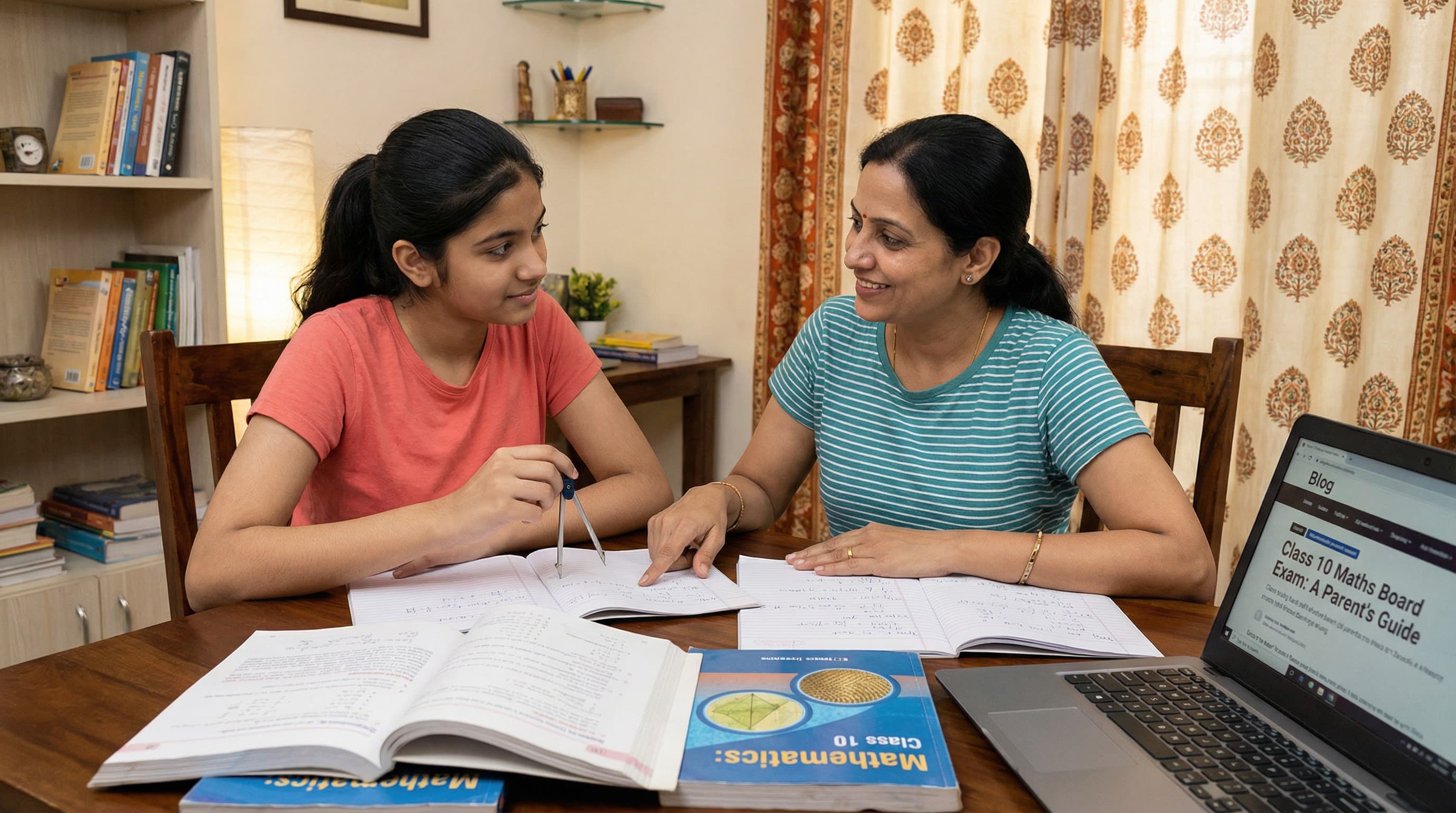
Mathematics education varies significantly across different countries, with each nation following its own curriculum standards, terminology, and teaching approaches. Whether your child is learning Math in the United States, Maths in the United Kingdom, or following curricula in Canada, Australia, New Zealand, Qatar, or the UAE, understanding these differences is crucial for academic success. This comprehensive guide explores how Math/Maths is taught from Grade 1 to Grade 10 (or equivalent) across seven major educational systems and explains how GuruForU's AI-powered platform can help your child master mathematics regardless of their location or curriculum.
Understanding Math vs. Maths: More Than Just Spelling
The first difference parents notice is the terminology: 'Math' in North America versus 'Maths' in the UK, Australia, and New Zealand. But the differences go far beyond spelling. Each country has unique curriculum structures, assessment methods, and learning progressions that can significantly impact your child's mathematical journey.
Understanding these differences helps parents support their children effectively, especially when relocating, switching schools, or preparing for international assessments. GuruForU's platform recognizes these regional variations and adapts instruction accordingly.
Terminology Differences
United States and Canada use 'Math' (singular), while the United Kingdom, Australia, and New Zealand use 'Maths' (plural, short for Mathematics). This reflects different philosophical approaches: American curricula often treat mathematics as a unified subject, while British-influenced systems emphasize mathematics as a collection of mathematical disciplines.
Curriculum Structure Variations
Each country organizes its mathematics curriculum differently. The US follows Common Core State Standards with grade-level progressions. The UK uses Key Stages (KS1-KS4) with the National Curriculum. Canada has provincial curricula. Australia follows the Australian Curriculum. New Zealand uses the NZ Curriculum. Qatar and UAE often follow British or American curricula in international schools.
Why This Matters for Your Child
When children move between countries or attend international schools, curriculum mismatches can create learning gaps. GuruForU's AI-powered system identifies these gaps and provides targeted instruction to ensure smooth transitions between different educational systems.
United States: Common Core Math Standards (Grades 1-10)
The United States follows Common Core State Standards for Mathematics, which emphasize conceptual understanding, procedural fluency, and real-world applications. The curriculum is organized by grade levels from Kindergarten through Grade 12, with clear learning progressions.
Common Core Emphasis on Understanding
US curricula focus heavily on 'why' not just 'how.' Students must explain their reasoning, use multiple solution strategies, and connect concepts across different mathematical domains. GuruForU's platform supports this by providing step-by-step explanations and encouraging multiple approaches to problem-solving.
Real-World Applications
Common Core emphasizes applying mathematics to real-world situations. Our tutors help students see connections between classroom math and everyday life, from calculating tips to understanding sports statistics.
- Grades 1-2 (Elementary): Focus on number sense, addition and subtraction within 100, place value, measurement, and basic geometry. Students learn to solve word problems and understand the relationship between addition and subtraction.
- Grades 3-5 (Upper Elementary): Introduction to multiplication and division, fractions, decimals, measurement conversions, area and perimeter, and data analysis. Grade 5 emphasizes fraction operations and decimal understanding.
- Grades 6-8 (Middle School): Ratios and proportional relationships, expressions and equations, number systems (including negative numbers), statistics and probability, and geometry (area, volume, surface area). Introduction to algebraic thinking.
- Grades 9-10 (High School): Algebra I (linear equations, functions, systems of equations), Geometry (proofs, transformations, trigonometry basics), and introduction to Algebra II concepts. Emphasis on mathematical modeling and problem-solving.
United Kingdom: National Curriculum and Key Stages (Years 1-10)
The UK uses the National Curriculum organized into Key Stages. Mathematics is called 'Maths' and follows a structured progression from Key Stage 1 (Years 1-2) through Key Stage 4 (Years 10-11, leading to GCSE).
GCSE Preparation
UK students take GCSE Mathematics at age 16, which is crucial for further education. GuruForU provides comprehensive GCSE preparation, covering both Foundation and Higher tier content, with practice on exam-style questions and problem-solving strategies.
Formal Written Methods
UK curriculum emphasizes formal written calculation methods (column addition, long multiplication, bus stop division). Our tutors ensure students master these techniques while understanding the underlying concepts.
- Key Stage 1 (Years 1-2, Ages 5-7): Number and place value, addition and subtraction, multiplication and division, fractions (halves and quarters), measurement, geometry (properties of shapes, position and direction), and statistics.
- Key Stage 2 (Years 3-6, Ages 7-11): Extended number work including larger numbers, formal written methods for all four operations, fractions and decimals, percentages, ratio and proportion, algebra introduction, measurement (including area, perimeter, volume), geometry (angles, coordinates), and statistics.
- Key Stage 3 (Years 7-9, Ages 11-14): Number (including negative numbers, powers, roots), algebra (expressions, equations, formulae, sequences), ratio and proportion, geometry and measures (including trigonometry), probability, and statistics. Preparation for GCSE.
- Key Stage 4 / GCSE (Years 10-11, Ages 14-16): Foundation and Higher tier options. Topics include number, algebra, ratio and proportion, geometry and measures, probability, and statistics. GCSE Mathematics is a compulsory subject with exams at age 16.
Canada: Provincial Curricula (Grades 1-10)
Canada doesn't have a national curriculum; each province develops its own. However, most provinces follow similar structures, with slight variations. Common elements include emphasis on problem-solving, mathematical communication, and connections between concepts.
Provincial Variations
While curricula are similar, provinces like Ontario, British Columbia, and Alberta have unique emphases. GuruForU's platform can adapt to specific provincial requirements, ensuring alignment with your child's school curriculum.
Problem-Solving Focus
Canadian curricula emphasize mathematical problem-solving and communication. Our tutors help students develop these skills through guided practice and real-world applications.
- Grades 1-3 (Primary): Number sense and numeration, measurement, geometry and spatial sense, patterning and algebra, data management and probability. Focus on developing number sense and basic operations.
- Grades 4-6 (Junior): Extended number operations, fractions and decimals, measurement (including area and perimeter), geometry (angles, transformations), data management, and introduction to algebraic thinking.
- Grades 7-8 (Intermediate): Number sense (including integers and rational numbers), algebra (expressions, equations, linear relationships), measurement and geometry (including surface area and volume), data management and probability, and proportional reasoning.
- Grades 9-10 (Secondary): Grade 9 typically covers number sense, algebra, linear relations, measurement and geometry, and data management. Grade 10 (or Grade 9 Academic) introduces more advanced algebra, quadratic relations, trigonometry, and analytic geometry.
Australia: Australian Curriculum (Years 1-10)
Australia follows the Australian Curriculum, Assessment and Reporting Authority (ACARA) framework. Mathematics (called 'Maths') is organized by year levels and content strands, with emphasis on mathematical proficiency: understanding, fluency, problem-solving, and reasoning.
Mathematical Proficiency Strands
Australian curriculum emphasizes four proficiency strands: understanding, fluency, problem-solving, and reasoning. GuruForU's AI-powered system develops all four strands through personalized practice and targeted instruction.
State-Based Senior Certificates
Years 9-10 prepare students for state-specific certificates like VCE (Victoria) or HSC (New South Wales). Our platform provides preparation aligned with these requirements.
- Years 1-2 (Foundation to Year 2): Number and algebra (counting, place value, addition, subtraction, multiplication, division), measurement and geometry (time, money, shapes, location), and statistics and probability (data collection and representation).
- Years 3-4 (Lower Primary): Extended number work, fractions and decimals introduction, measurement (including area), geometry (angles, symmetry), and data representation. Introduction to formal problem-solving strategies.
- Years 5-6 (Upper Primary): Number and algebra (including decimals, percentages, integers), measurement (including volume and capacity), geometry (including transformations), and statistics and probability (including chance experiments).
- Years 7-8 (Lower Secondary): Number and algebra (including ratios, rates, percentages, linear equations), measurement and geometry (including Pythagoras' theorem, area and volume formulas), and statistics and probability (including probability calculations).
- Years 9-10 (Middle Secondary): Number and algebra (quadratic equations, indices, surds), measurement and geometry (trigonometry, circle geometry, similarity), and statistics and probability (including conditional probability). Preparation for VCE, HSC, or other state-based senior certificates.
New Zealand: NZ Curriculum (Years 1-10)
New Zealand follows the New Zealand Curriculum, which organizes mathematics into number and algebra, geometry and measurement, and statistics. The curriculum emphasizes mathematical thinking and problem-solving in authentic contexts.
Authentic Contexts
NZ curriculum emphasizes learning mathematics in authentic, real-world contexts. Our tutors connect mathematical concepts to New Zealand-specific examples and situations relevant to students' lives.
NCEA Preparation
Years 9-10 prepare students for NCEA (National Certificate of Educational Achievement). GuruForU provides NCEA-aligned instruction and practice.
- Years 1-3 (Junior Primary): Number knowledge and strategies, geometry (shapes, position, orientation), measurement (length, area, volume, time, money), and statistics (collecting and displaying data).
- Years 4-6 (Senior Primary): Number strategies and knowledge (including fractions, decimals, percentages), algebra (patterns and relationships), geometry and measurement (including angles, area, volume), and statistics (including probability).
- Years 7-8 (Intermediate): Number (including integers, ratios, rates), algebra (expressions, equations, graphs), geometry and measurement (including transformations, Pythagoras), and statistics and probability.
- Years 9-10 (Lower Secondary): Number (including surds, indices), algebra (quadratic equations, simultaneous equations), geometry and measurement (trigonometry, circle geometry), and statistics and probability. Preparation for NCEA Level 1.
Qatar and UAE: International Curricula (Grades 1-10)
Qatar and the United Arab Emirates host diverse international schools following various curricula. Most common are British (UK National Curriculum), American (Common Core or state standards), and International Baccalaureate (IB) programs. Understanding which curriculum your child's school follows is essential.
Curriculum Identification
The first step is identifying which curriculum your child's school follows. GuruForU's platform can adapt to any of these systems, ensuring instruction aligns with your child's school requirements.
Cultural Sensitivity
Our tutors understand the unique context of international schools in the Middle East and can provide culturally sensitive instruction while maintaining high academic standards.
- British Curriculum Schools: Follow UK National Curriculum with Key Stages, GCSE preparation, and 'Maths' terminology. Same structure as UK schools with adaptations for international context.
- American Curriculum Schools: Follow Common Core State Standards or specific US state standards. Use 'Math' terminology and grade-level organization. Often include SAT/ACT preparation in high school.
- IB Schools: Follow International Baccalaureate Mathematics framework with emphasis on inquiry-based learning, international-mindedness, and connections between mathematical concepts and real-world applications.
- Local Curricula: Some schools follow Qatar or UAE national curricula, which often incorporate elements from British and American systems while including local cultural contexts.
Key Differences: What Parents Need to Know
Understanding these key differences helps parents support their children effectively and make informed decisions about their mathematical education.
- Grade/Year Terminology: US and Canada use 'Grade' (Grade 1-10), UK uses 'Year' (Year 1-10), Australia and New Zealand also use 'Year.' International schools may use either system. GuruForU adapts terminology based on your location.
- Assessment Methods: US uses standardized tests and Common Core assessments. UK uses SATs (Key Stage 2) and GCSE exams. Australia uses NAPLAN and state-based certificates. Canada uses provincial assessments. Understanding assessment formats helps preparation.
- Mathematical Notation: Some differences exist in notation (e.g., decimal points vs. commas in some European-influenced systems). Our platform uses notation appropriate to each curriculum.
- Problem-Solving Approaches: British curricula often emphasize formal written methods earlier. American curricula may emphasize multiple strategies. Our tutors teach methods aligned with your child's curriculum.
- Algebra Introduction: Timing varies—some curricula introduce algebra concepts in Grade 6/Year 7, others wait until Grade 8/Year 9. GuruForU ensures your child learns algebra at the appropriate time for their curriculum.
Common Math Topics Across All Curricula (Grades 1-10)
Despite differences, all major curricula cover similar mathematical concepts, just at different times and with varying emphasis. Here's a general progression that applies across most systems.
Grades 1-3 / Years 1-3: Foundation Building
All curricula focus on number sense, basic operations (addition, subtraction, multiplication, division), place value, measurement basics, simple geometry (shapes, patterns), and introduction to data representation. GuruForU's early elementary programs build these foundations with engaging, age-appropriate activities.
Grades 4-5 / Years 4-6: Intermediate Skills
Extended number operations, fractions and decimals, measurement (area, perimeter, volume basics), geometry (angles, symmetry), and data analysis. This is where curricula begin to diverge more significantly. Our platform identifies your child's curriculum and provides appropriate instruction.
Grades 6-8 / Years 7-9: Pre-Algebra and Advanced Concepts
Ratios and proportions, negative numbers, algebraic thinking, advanced geometry, statistics and probability, and introduction to more formal mathematical reasoning. Preparation for high school mathematics begins here.
Grades 9-10 / Years 9-10: High School Preparation
Algebra (linear and quadratic equations), geometry (including trigonometry in some curricula), advanced number concepts, and mathematical modeling. This level prepares students for advanced mathematics, standardized tests, and future academic or career paths.
How GuruForU Helps Students Across All Curricula
GuruForU's AI-powered platform is designed to support students regardless of their location or curriculum. Our system adapts to regional differences while ensuring comprehensive mathematical mastery.
Curriculum-Specific Instruction
Our platform automatically detects your location and adapts instruction to match your child's curriculum. Whether they're learning Common Core Math, UK National Curriculum Maths, Australian Curriculum, or any other system, instruction aligns with school requirements.
Terminology Adaptation
We use appropriate terminology—'Math' for US/Canada, 'Maths' for UK/Australia/NZ. Grade levels are presented correctly (Grade vs. Year), and mathematical notation matches regional standards.
Gap Identification and Remediation
When students move between countries or curricula, learning gaps can occur. Our AI identifies these gaps and provides targeted remediation, ensuring smooth transitions and preventing knowledge gaps from hindering progress.
Comprehensive Coverage
From basic number sense in Grade 1/Year 1 to advanced algebra and geometry in Grade 10/Year 10, GuruForU covers all topics across all major curricula. Our content library includes thousands of problems, explanations, and practice exercises aligned with each curriculum.
- Personalized Learning Paths: Our AI creates individualized learning paths based on your child's current level, curriculum, and learning pace. No two students follow the exact same path.
- Real-Time Progress Tracking: Parents receive detailed reports showing mastery of specific topics, areas needing improvement, and progress toward curriculum goals.
- Expert Tutors: Our qualified tutors understand curriculum differences and can provide targeted support for specific topics, exam preparation, or curriculum transitions.
- Exam Preparation: Whether preparing for GCSE, NAPLAN, provincial assessments, SAT, or other exams, our platform provides curriculum-aligned test preparation.
- 24/7 Access: Students can practice and learn anytime, anywhere, with AI-powered feedback and explanations available around the clock.
Special Considerations for International Students
Students in international schools or those who relocate frequently face unique challenges. GuruForU addresses these specific needs.
Curriculum Transitions
When moving from one curriculum to another (e.g., US to UK, or British to Australian), students may encounter topics in different orders or with different emphasis. Our platform identifies what your child knows and what they need to learn in the new curriculum, creating a bridge between systems.
Language and Terminology
Mathematical language varies between curricula. We help students understand terminology differences (e.g., 'trapezium' in UK vs. 'trapezoid' in US) and ensure they can communicate mathematically in their current educational context.
Assessment Preparation
Different curricula have different assessment formats. GCSE exams differ from Common Core assessments, which differ from NCEA. Our platform provides practice aligned with your child's specific assessment requirements.
Grade-by-Grade Support: How GuruForU Covers Grades 1-10
Here's how GuruForU supports your child at each grade level, regardless of curriculum:
- Grades 1-2 / Years 1-2: Building number sense, basic operations, and mathematical confidence. Interactive games and visual learning make early mathematics engaging and fun.
- Grades 3-4 / Years 3-4: Developing multiplication and division fluency, introduction to fractions, measurement skills, and problem-solving strategies. Our platform makes abstract concepts concrete through visual models.
- Grade 5 / Year 5: Critical year focusing on fractions, decimals, geometry, and multi-step problem-solving. This is where many students need extra support, and GuruForU provides comprehensive coverage of all Grade 5/Year 5 topics.
- Grades 6-7 / Years 6-7: Introduction to ratios, percentages, negative numbers, and algebraic thinking. Our tutors help students make the transition from arithmetic to more abstract mathematical thinking.
- Grade 8 / Year 8: Advanced pre-algebra, linear equations, functions, and geometric transformations. Preparation for high school mathematics begins in earnest.
- Grades 9-10 / Years 9-10: Algebra, geometry (including trigonometry), and advanced problem-solving. Our platform prepares students for high-stakes exams, advanced courses, and future academic success.
Success Stories: Students Thriving Across Curricula
GuruForU has helped students successfully navigate curriculum differences and achieve mathematical excellence. Here are examples of how our platform supports diverse learning needs.
US to UK Transition
A student moving from US Grade 5 to UK Year 6 needed to catch up on formal written methods and prepare for Key Stage 2 SATs. GuruForU identified specific gaps, provided targeted instruction, and the student successfully transitioned with confidence.
GCSE Preparation
A Year 10 student in the UK needed extra support for GCSE Mathematics. Our platform provided Foundation and Higher tier practice, exam-style questions, and personalized tutoring, resulting in improved grades and exam confidence.
International School Support
A student in a Dubai international school following a hybrid curriculum needed support aligning with both British and local requirements. GuruForU's flexible platform adapted to provide comprehensive coverage.
Tips for Parents: Supporting Your Child's Math Journey
Regardless of which curriculum your child follows, these strategies help support their mathematical success.
- Understand Your Child's Curriculum: Know which system your child's school uses. This helps you provide appropriate support and choose relevant resources.
- Focus on Understanding, Not Just Answers: All modern curricula emphasize conceptual understanding. Help your child explain their thinking, not just get correct answers.
- Use Curriculum-Appropriate Resources: Ensure practice materials align with your child's curriculum. GuruForU automatically provides curriculum-aligned content.
- Celebrate Progress: Mathematics is challenging. Celebrate effort and improvement, not just perfect scores. Building mathematical confidence is crucial.
- Connect Math to Real Life: Show how mathematics applies to everyday situations—cooking, shopping, sports, travel. This makes math meaningful and relevant.
- Communicate with Teachers: Understand what your child is learning in school and how you can support it at home. GuruForU's progress reports help facilitate these conversations.
The Future of Math Education: Preparing for Success
As mathematics education evolves globally, students need strong foundations regardless of their curriculum. Whether your child is preparing for GCSE, high school algebra, university entrance exams, or simply building mathematical confidence, GuruForU provides comprehensive support.
Our AI-powered platform recognizes that mathematics is universal, but how it's taught varies. By adapting to regional curricula while maintaining high standards, we ensure every student can achieve mathematical mastery from Grade 1 to Grade 10 and beyond.
Frequently Asked Questions
What's the difference between Math (US) and Maths (UK)?
Terminology: US and Canada use 'Math'; UK, Australia, New Zealand use 'Maths.' More importantly, curriculum structure, progression, and assessment methods differ by country.
How does Common Core (US) differ from UK National Curriculum?
Common Core emphasizes conceptual understanding and real-world application. UK uses Key Stages with GCSE exams. Both cover similar concepts but with different sequencing and assessment.
What if my child switches between countries or curricula?
Curriculum mismatches can create gaps. Look for platforms that identify gaps and provide targeted instruction to ensure smooth transitions between systems.
Do Qatar and UAE follow a specific math curriculum?
International schools in Qatar and UAE often follow British (Cambridge, Edexcel) or American (Common Core) curricula. Check your school's affiliation.
Master Math Across Any Curriculum with GuruForU
Whether your child is learning Math in the US, Maths in the UK, or following curricula in Canada, Australia, New Zealand, Qatar, or the UAE, GuruForU's AI-powered platform adapts to their specific curriculum needs. Our expert tutors understand curriculum differences, our content aligns with regional standards, and our personalized learning paths ensure your child masters mathematics from Grade 1 to Grade 10. Get started with a free consultation to see how we can support your child's mathematical journey, regardless of where they learn.
Book Your Free Math Assessment